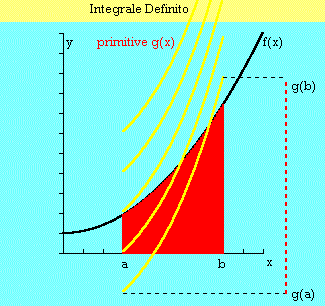


| The theorem of Torricelli allows the definite integrals calculus, avoiding the calculus of limit of series, searching for a primitive of the given function. If g(x) is any primitive function of f(x) it has the form: | |||
| x | |||
| g(x)= | òf(t)dt+k Putting x = a we obtain: | ||
| a | |||
| a | a | ||
| g(a)= | òf(t)dt+k that is to say k=g(a) (since | òf(t)dt=0) | |
| a | x | a | |
| Replacing g(a) to k:: g(x)= | òf(t)dt+g(a) | ||
| a | |||
| x | |||
| from which, inversely: | òf(t)dt=g(x)-g(a) | ||
| a | |||
| b | |||
| Finally, replacing b value to x: | òf(t)dt=g(b)-g(a) | ||
| a | |||